The Rajah Quilt

The Rajah Quilt

Wednesday, June 12, 2013

Bodmin Jail

It was a cold, wet day in June 2012, when we visited the Bodmin Jail, in Cornwall.  This is the prison where Charles Blight was held in 1834, after his conviction for wounding a sheep.  The Jail is now a private tourist operation, and well worth a visit. The current owners saved the site from a derilect state in 2004, and are continually restoring the buildings. It has an excellent restaurant, and some great books on the history of the jail. They concentrate on the notorious local prisoners convicted for murder, and sentenced to execution.  The hanging of brothers James and William Lightfoot on 13th April 1840 attracted a crowd of 25,000 plus some 1,100 passengers on a train, which halted below the prison so that those on board could see the execution.  One of the main attractions of Bodmin Jail today is a daily re-enactment of a hanging at the restored gallows. 


The original Bodmin Prison was built in in the reign of George III, in 1779. Based on the reforms of the 1778 Act of Parliament, the site was chosen for its clean air and pure water, which would help in reducing disease.   Three prison areas were designed to separate minor misdemeanants, felons (major crimes) and debtors, as well as segregating men and women.  Bodmin was also one of the first jails with prisoners kept in individual cells. 
 
The entire prison was rebuilt in the 1850's after being declared unfit for purpose, due to changes in legislation which required total segregation of remand prisoners, convicted prisoners, felons, misdemeanants, debtors, vagrants and of course, men from women. This resulted in over 20 different classes of prisoners; each group had to be housed in separate sleeping areas and workshops.  A new 220-cell prison was built from the late 1850's - it is these buildings that remain on the site.


Notice on the wall inside the restored prison, naming Charles Blight amongst prisoners transferred to London prior to their transportation. At the time when Charles Blight was in Bodmin Jail, it was a different building to the one that is currently on the site.


 Remains of the Naval Prison from 1887.


Sunday, March 3, 2013


Convict Lives at the Launceston Female Factory

Convict Women's Press


On Saturday February 23rd, 2013, the new book, from Tasmanian publishing group Convict Women's Press; 'Convict Lives at the Launceston Female Factory', was officially launched at the Cascades Female Factory Historic Site, in Hobart.
 
The book contains 34 stories about the lives of convict women who at some stage encountered the walls of the Launceston Female Factory.  Contributors range from historians, professors and family members, all keen to continue to bring the stories of female convicts to life. 
 
A few of the authors, along with myself, are direct descendants of the women they wrote about. 
Grace's story is included in this book, and Grace's photo on the front cover!


In a costume that belongs to the Female Factory - attempting to replicate the pose in the original photo of Grace
 

Signing copies of the books

 
The launch was a great celebration for all the authors.


Gary and I dressed for the occasion - Sam said we look like the Pastor and his wife :)


A photo of Grace, date unknown, current owner of this photograph also unknown - I would like to find out who has the copy that this image was made from.

 
More signing.


The Premier of Tasmania, the Honourable Lara Giddings, was official guest speaker at the launch.

 
I, along with 2 other contributors, was asked to read a short section of my story at the launch.


Sunday, October 21, 2012

Centenary Celebrations for St Brigid's Catholic Church Wynyard

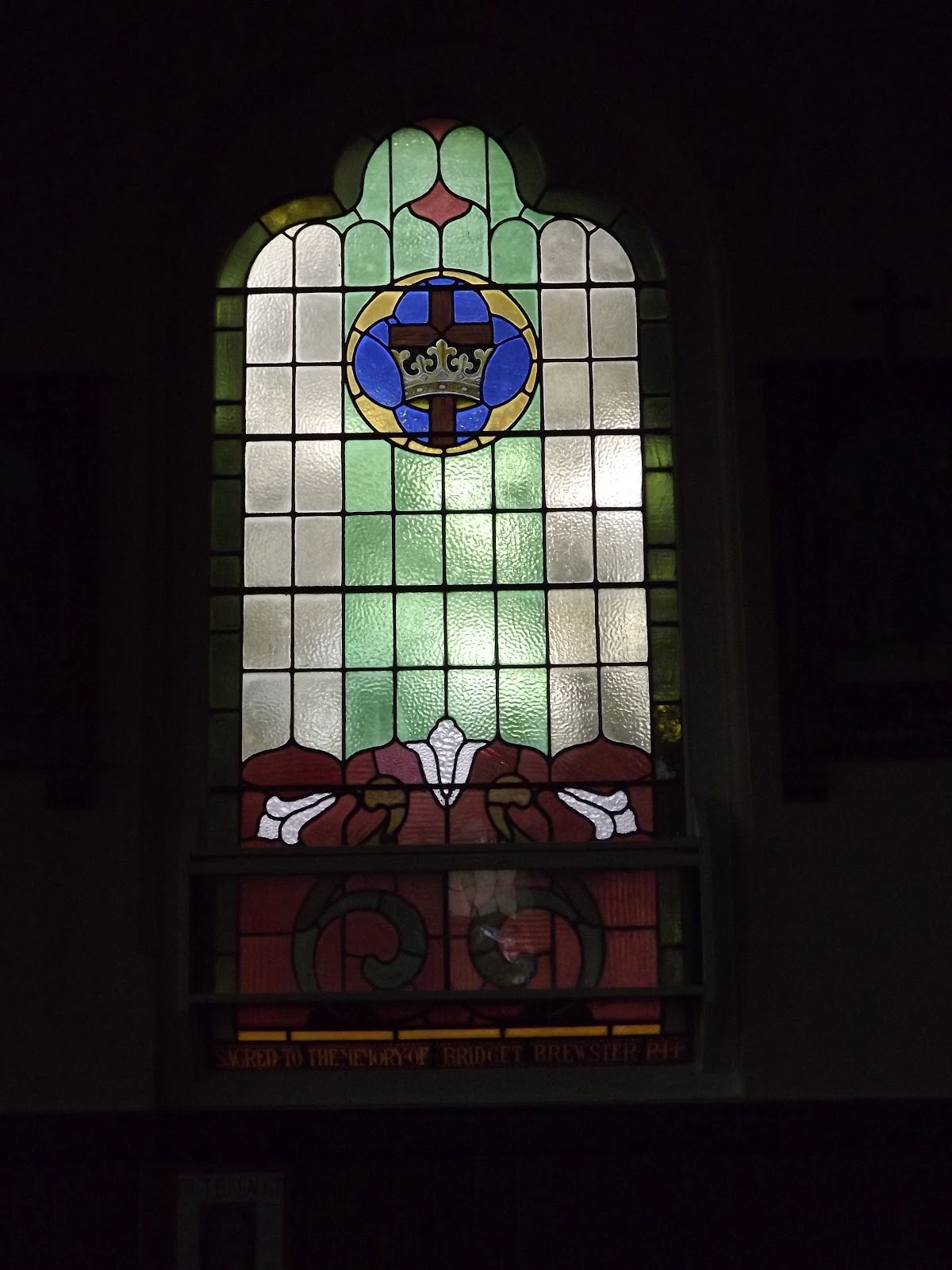
When I first contacted the church about taking photos of the window for the Female Convict's Research Group, I was invited to the centenary celebrations, as a person with a connection to Bridget Brewster, nee Cassidy (see previous post).


St Brigids in 1912 - photo from State Library of Tasmania
Saturday October 13th 2012 was the day of celebration for the 100th anniversary of St Brigid's church in Wynyard.  The iconic new church was opened in 1912, and replaced the nearby wooden church built in 1876.
When Archbishop Patrick Delaney travelled from Hobart to Wynyard to lay the foundation stone on May 28, 1911, he saw the plans and said it was far too large and grandiose, and made Father T. J. O'Donnell move the stone 6 m (20 feet).  After the Archbishop departed, Father T. J. moved the stone back to it's original position.
The  O'Neill family provided the iron, and together with the Brewster family donated the original altar for the new church.


Interior of St Brigids, Archbishop Adrian Doyle

The church shares design features with Westminster Cathedral in London, completed in 1903. The design of red brick with light bands is known colloquially as 'blood and bandages'.


Westminster Cathedral, London 2004

Westminster Cathedral Precint, London, 2004


We were told that the dress for the celebration would be in the style of 1912.  We decided to make a day of it with the Tulip Festival on the same day, and wore our costumes out for the afternoon


A bus load of international students arrived at the tulip farm, just after we did.  I'm sure they thought we were part of the day's attraction :)


I'm sure I had my photograph taken with most of this group :)

We also visited the 'Wonders of Wynyard' exhibition of vintage transport, and I discovered another treasure, a Singer No. 3 treadle.


With a little time to fill in, we 'visited' Bridget and Thomas, who are buried at the old general cemetery, Jenner St, Wynyard.


Returning to town for the mass at 5 p.m. we sat next to Bridget's window.


.
Since this journey of discovery began, I have been contacted by 3 descendants of Bridget and Thomas, and it's to them that I dedicate this post.
 
Bernadette. 


Sunday, September 2, 2012


Introducing Bridget Cassidy.

Dr Trudy Cowley contacted me a couple of months ago with an interesting request :).  Could I photograph a window, in the Catholic Church at Wynyard?  Well, sure, I reckon I could do that.  And guess what, there's a family connection - for me.   The window is dedicated to Bridget Brewster.  Ok.
Bridget was born at County Monaghan, in Ireland, in about 1830.  At her trial on 5 March 1849, she was convicted for stealing 2 quilts, and sentenced to 7 years transportation.  19 year old Bridget was transported on the Australasia, departing Dublin on 26 June and arriving in Hobart on 29 September, 1849.  On arrival, she and her fellow prisoners spent 6 months at the Anson Probation Station, a hulk moored in the Derwent, where Bridget was classified as a 3rd class, or Crime Class prisoner.  These women were the least well behaved, and were put to hard labour.


Between arrival, and when her sentence expired, Bridget was constantly in trouble with the authorities, with 8 records of being in either Ross or Launceston Female Factories (prisons).   During this time, Bridget was on 2 occasions the subject of ‘Convict Permission to Marry’, and had 2 daughters, with the men she hoped to marry.  Elizabeth b. 1853, (father Robert Roach), and Caroline Anastasia, b. 1855, (father William Green), but things evidently did not work out with either request for permission to marry.   Elizabeth, as the illegitimate daughter of a convict woman under sentence, was placed in the Queen’s Orphan School in Hobart. 

On 10th February 1857 Bridget married Thomas Ambrose BREWSTER, also a convict (Eden).  The marriage took place at the home of George Ramskill, at Table Cape.

Bridget and Thomas had 4 sons and 3 daughters –
John Francis b. 1857, Albert Joseph Sylvester b. 1859, Thomas, b. 1861, Sarah Ann b. 1864, Isabella Eudora b. 1866, Frederick Vincent b. 1868, and Mary b. 1870.  Caroline, Bridget’s second daughter before her marriage, stayed with the family, and Elizabeth was discharged to her mother’s care from the Orphan School in 1863, when she was about 10 years old.

Of Bridget's children, Thomas Brewster b. 1861 died unmarried in 1889.  John Francis Brewster did not marry as far as I can tell, no spouse or children mentioned in his obituary in 1928.  Mary, the youngest daughter, also appears to have remained unmarried until her death in 1940.
Son Albert was an interesting character.  In September 1877, only 18, he was acquitted of a charge of forgery and uttering.  In 1886 he was assaulted while a police constable in Launceston, and in 1887 was charged with perjury in a case he was prosecuting, falsely testifying against the accused, of having used indecent language.  In October 1887 Albert was prosecuted for leaving his illegitimate child, to Lousia Davis, without means of support.  The case was discharged.

In 1890 Albert, with 3 other men, was charged with ‘riotously disturbing the peace by fighting’. They each paid a £25 fine and were given a good behaviour bond.
On 8 January 1891, Albert Joseph Brewster married Grace Elizabeth Alice Louchlon Blight, at her father’s residence, Pine Road near Ulverstone; Albert aged 27, bachelor, miner; Grace aged 22, spinster, domestic; witnesses Emma Amelia Louchlon Hayes and James Hayes.  Grace’s father was John Lachlan Blight, son of Grace nee Stevens and Charles Blight; her mother was Ellen Blight nee Dewhurst, daughter of Charles Dewhurst and Elizabeth Banks.  This is where the family is connected to mine, as John and Ellen are my gggg-uncle and aunt, one of the 3 pairs of step-brothers and sisters to marry from the 2 families of Grace and Charles.
Grace and Albert had 2 sons, John Thomas Mervyn b. 1891, and Albert Richard Avondale b. 1896.
The troubled times weren’t over for Albert, who was declared insolvent in January 1893, with liabilities of £134.  In November 1901 he was a passenger in a Tatlow’s coach which crashed near Boat Harbour, but suffered only minor injuries.

Grace Alice Brewster nee Blight died Sept 4th 1902, aged 36 years.
In 1908, Albert, calling himself Albert Cassidy, stating his parents’ names Thomas Cassidy and Bridget O’Connor, married Alice Veronica Hammond in Victoria.  They had a son James Alfred In 1909, and a daughter Monica Aileen in 1912.
Albert Richard Avondale Brewster was thrown from a horse and killed age 13 years on 30 October 1909 near Flowerdale.  His mother had died and his father had run off to Victoria, young Albert was living with Bridget and Thomas at Flowerdale.

Marriages of the other Brewster children:
Caroline Green m. Joseph MORTON
Sarah Ann Brewster m. Thomas Stephen BERECHREE
Frederick Vincent m. Lizzie WELLS
Isabella Eudora BREWSTER m. John O’NEILL
Bridget Brewster nee Cassidy died on 20 December 1908 and is buried in the Old General Cemetery at Jenner St, Wynyard.
Thomas Ambrose Brewster erected a stained glass window in the St Brigid’s Catholic Church, Wynyard, in honour of his wife.


Thomas died on 17 August 1912. His funeral took place the same day as the opening of the new church.  He, along with son Thomas, is buried in the same plot as Bridget at Wynyard.


Sunday, April 15, 2012

HMS RAJAH

The Rajah was a barque - a sailing ship with 3 masts, which weighed 352 tons, built at Whitby in 1835.  This is the style of ship that she was:


The Rajah was a commercial ship - from 1838 to 1851 her Master was Captain Charles Ferguson, a Scot, who was only 25 at the start of his association with the Rajah.  Working between Britain, India and Australia the Rajah carried passengers and merchandise.

At the end of 1840 she was fitted out for convict transport.  The journey which began on 5th April 1841 was her only voyage as a convict ship.  On board for this journey was Miss Kezia Hayter, who was part of the group formed by Elizabeth Fry, hoping to provide female prisoners with skills for a better life.  Captain Ferguson and Miss Hayter became engaged in Hobart at the conclusion of the voyage. 

After the Rajah arrived in Hobart on 19th July 1841, the prison fittings were dismantled.  They formed part of a Government auction, advertised on the 3rd of August 1841, just 2 weeks after arrival.   The Rajah returned to commercial business, leaving Hobart on the 22nd of August bound for India, with passengers and freight. 

Kezia stayed behind while her beau travelled off, he didn't return until the 23rd June 1843.  On the 1st of July 1843 they were married, at St Andrew's Presbyterian Church, Hobart.

A quote often seen on websites, where people are writing about the Rajah Quilt:

'the patchwork only lasted 2/3 of the voyage and that the women talked as they sewed, and that the conversation was obscene'

This quote, while memorable, can't be about the Rajah Quilt - since it's source is quoted as from a Select Committee Report into Transportation - in 1838. 


Saturday, April 14, 2012

Research and ye shall find.

While I have been researching into more background for Grace's story, I have made some amazing discoveries.  What a wonderful thing the internet is, it's fantastic that there are so many historical records and documents now available on line, many for free.  This often means that volunteer transcribers have spent the time recording, scanning, typing or copying, old records from churches, newspapers, archives, and other official documents.


I knew that it said in Grace's convict records that she had one prior conviction for theft of fabric.  In the West Briton and Cornwall Advertiser, Friday the 10th of January 1840, it was reported that at the Penzance Quarter sessions of the previous Monday (6th January) Grace STEVENS, 15, pleaded guilty to stealing a piece of cotton print, from the shop of Mr. Tucker, Draper, and was sentenced to three months' imprisonment. 


http://freepages.genealogy.rootsweb.ancestry.com/~wbritonad/index.html


Her second conviction, that earned her the sentence of transportation to Van Diemen's Land, was reported in the Cornwall Gazette on Friday 17th July 1840.  This report says her trial had taken place on Tuesday of that week, the 14th of July.  This one is not on-line.


On Google Books I found the Sixth Report of Inspectors of Prisons of Great Britain, to the House of Commons, 1841.  Prison Inspector for the Southern and Western area, of Great Britain, Dr Francis Bisset Hawkins (an eminent physician and social reformer), visited the Penzance Town Gaol and House of Correction on 16th July 1840. 

On the day of his visit to the Penzance Gaol and House of Correction, he reported that the gaol held 10 prisoners, 7 women, one man, one boy and ‘a girl 15, sentenced to Transportation’.   Grace, having been sentenced to Transportation at Penzance two days earlier, on the 14th, was the only person who could fit this description on the 16th of July.

 In reporting on the prisoner's literacy levels, he noted  “of the prisoners now here, 1 girl (who is for transportation) has not been to any school;”.  Grace again.

The report gives a glimpse into prison life: “The Keeper does not allow talking. […] The prisoners do not go outside the walls to work, on any pretext.  Tobacco is forbidden.  On the night preceding my visit, all the women slept in single or double cells -- one by herself, and six, two in a bed.”
 Construction.—There are six cells here, three in the male yard and three in the female; one dark room; and two yards (besides the tread-wheel yard).  There are no day-rooms; but the cells are large and each has a fire-place.”
“Diet. – The keeper receives 2s. 6d. per week for each prisoner, for which he is obliged to find them 1 ½ lb. of seconds bread daily, and 1 ½ pint of tea morning and evening; also for dinner, on Sundays, 4 ozs. Meat and 1 ½ lbs potatoes; Mondays, soup, with ½ lb. of bread extra; Tuesdays, stew with 4 ozs. of meat and 1 ½ lbs. of potatoes; Wednesdays 4 ozs. of fish and 1 ½ lbs. of potatoes; Thursdays 4 ozs. of liver and 1 ½ lbs. of potatoes; Fridays, the same as Mondays; Saturday’s, the same as Wednesdays.  Salt is given without limit.” 
Dr Bisset Hawkins made some recommendations at the conclusion of his inspection, including that “A bath of some kind is wanted”, and that “Tread-wheel labour is, in my opinion, unsuitable for women.”

Born in 1796, Dr Hawkins, wrote the first book on medical statistics in English in 1829. The book was influential in the use of hospital records and in the insertion of cause of death in registration documents.  He was a prolific author in the fields of industrial medicine and public health.  
He held the important offices of factory commissioner, to which he was appointed in 1833; of inspector of prisons, in 1836; and of metropolitan commissioner in lunacy, in 1842. In 1847-48 he was commissioner for the government of the Model prison at Pentonville, and in 1858 was appointed a deputy lieutenant of Dorsetshire. In his Report on the Health and Condition of the Manufacturing Districts, he strongly recommended the diminution of the hours of labour for children and women; and suggested the creation of public gardens or parks at Manchester.
His picture above is from the British Medical Journal of January 1895, published after his death in December 1894. To think that Grace saw this man in 1840, is really incredible. 


Sunday, March 25, 2012

Grace in print?

Hello,

The Convict Women's Press is a group that publishes stories about women convicts, their lives, their crimes, and how they fared in later life.  The 'Convict Lives' series currently has books about the Cascades Female Factory and the Ross Female Factory.  The books contain a set of short stories for selected convict women, who were in some way connected to one of the female factories.

The current project is the Launceston Female Factory.  Grace spent some time in the Launceston Female Factory in early 1843.  I am writing up her story to contribute to the book.  She may or may not make the final cut :)

Last weekend I went to a workshop for contributors, held at the beautiful 'Egremont' in Launceston.  It is a stunning turn of the century house with magnificent Art Nouveau decor, including decorative fireplaces, ceilings, and stained glass windows.

What a stunning place to visit!

Four other writers attended the workshop and it was fascinating to hear the stories they were researching,  I was the only person writing about a direct ancestor, in the group.  

While researching my article I have found out a couple of interesting but sad things about Grace that I hadn't realised before. Grace's mother Martha died in 1826 when Grace was only 18 months old.  I can't find any information about how her father Robert managed with 3 young children - but her mother came from a large family, so hopefully they were able to help care for them.  Her older brother Robert (jr) died about 12 months after their mother in 1827, when he was only 10 years old. 

UK online census information doesn't start until 1841 - the year Grace was transported.